
Understand the board before you buy it.
Short, practical guides to size, volume, shape, construction, progression and care.
The essential buying guides.

Understand the main categories.
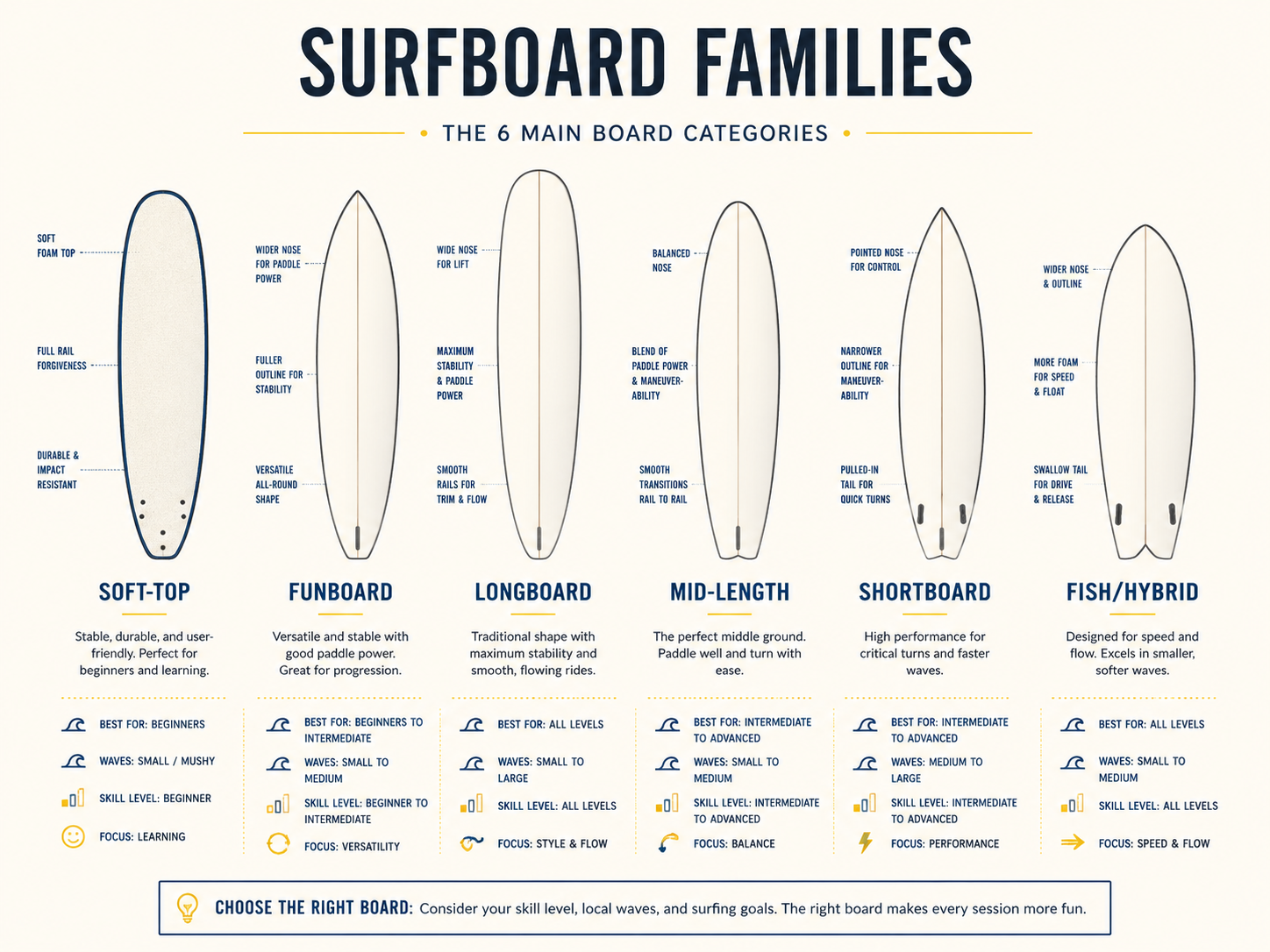
Soft-Tops
Stable, safer and a practical way to learn.
Funboards
A useful bridge between beginner boards and more performance-focused shapes.
Longboards
Glide, easy wave entry and a style of surfing all their own.
Mid-Lengths
Paddle power and flow, with more response than a traditional longboard.
Shortboards
Fast and responsive, but they demand more from the surfer.
Fish and Hybrids
Extra speed and usable volume in a more compact shape.
What actually changes the ride.
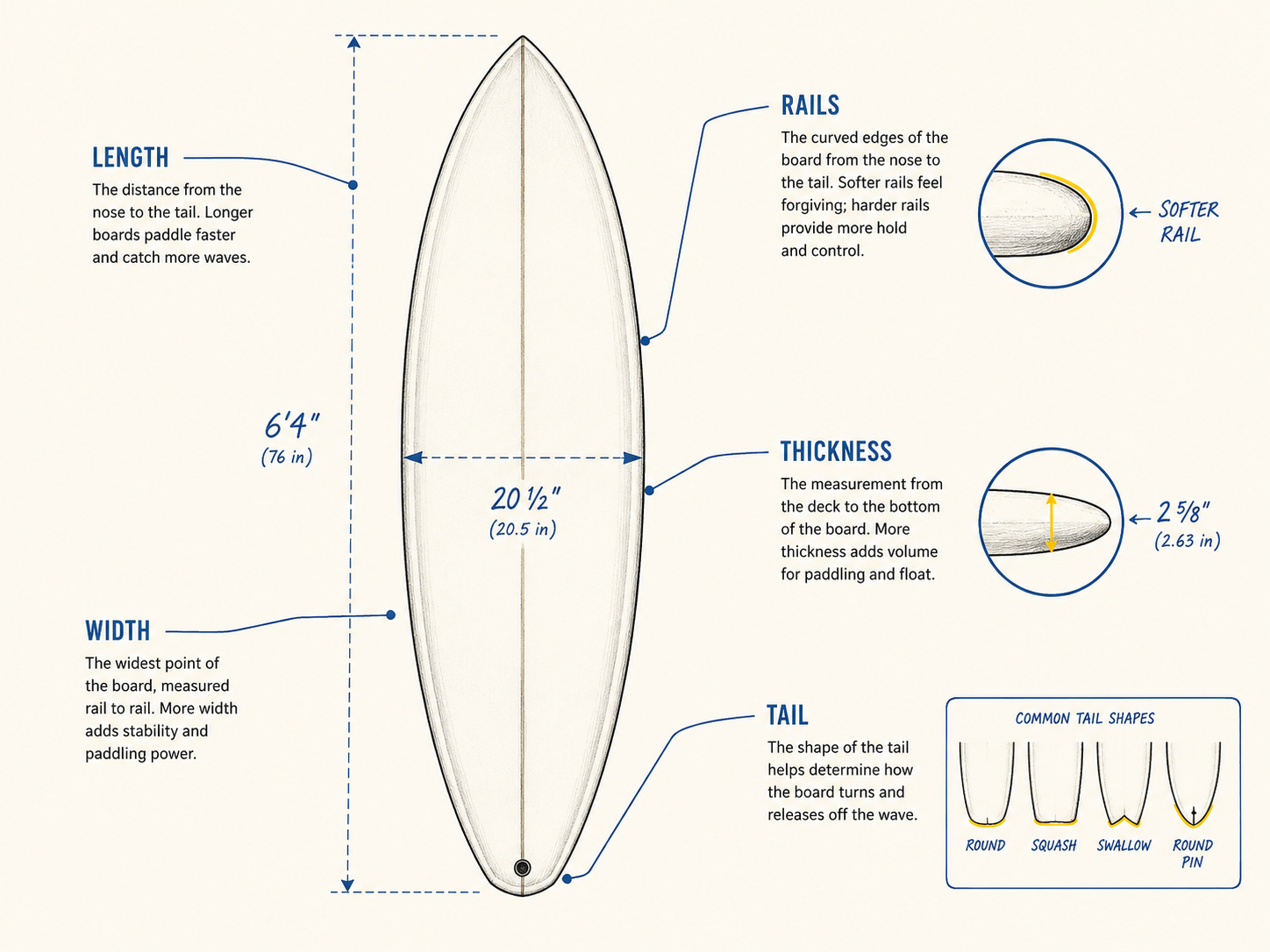
Surfboard Length, Width and Thickness
Length, width and thickness work together to shape paddling, stability, turning and flotation. None of the dimensions should be judged alone.
Read the full guideSurfboard Rocker Explained
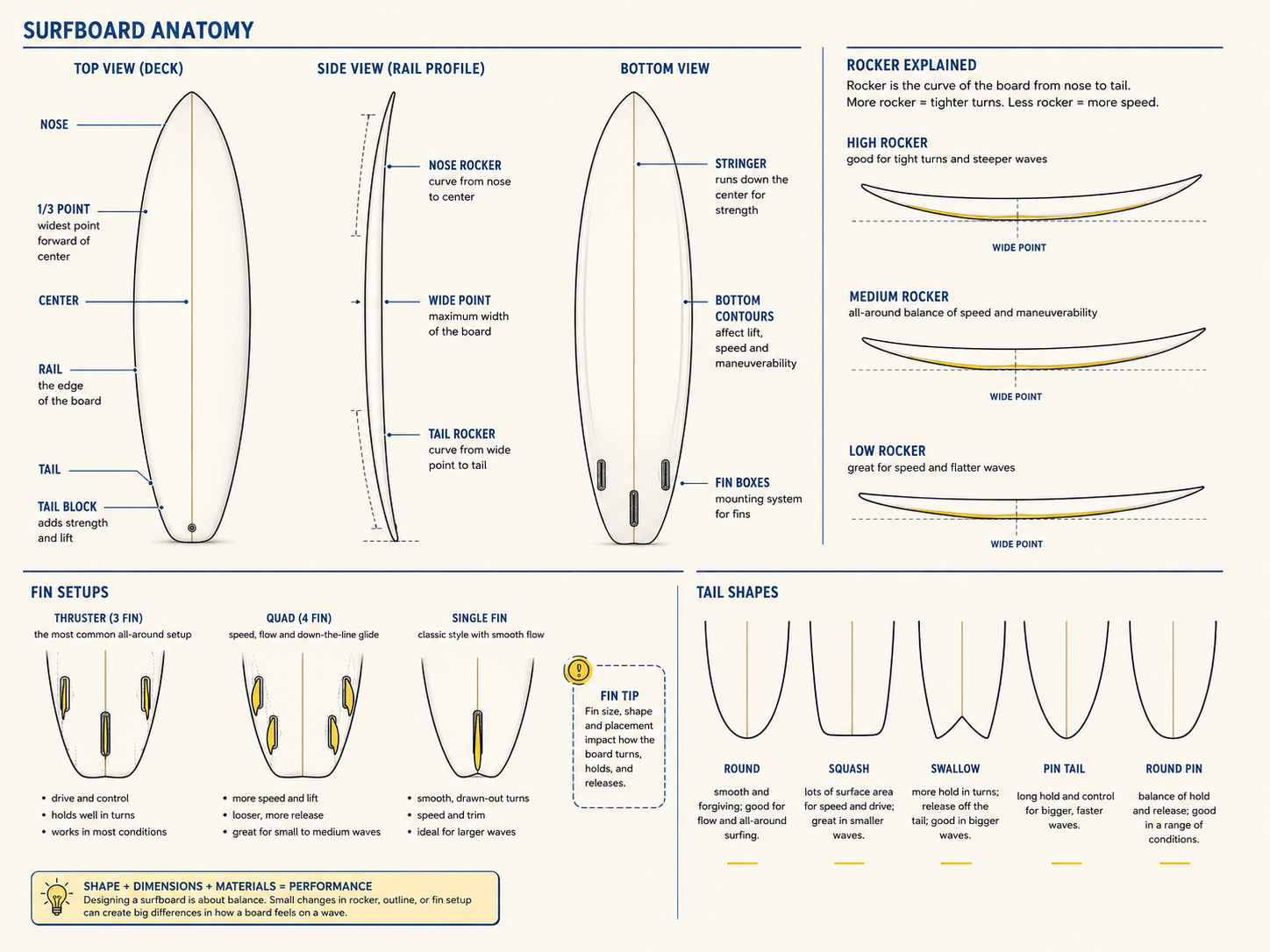
Rocker is the curve of the surfboard from nose to tail. Flatter rocker can support speed and paddling, while more curve can help a board fit steeper sections, though the complete shape determines the result.
Read the full guideSurfboard Rails Explained
Rails are the edges of the surfboard that meet the wave face. Their thickness and shape affect how easily the board engages, releases and holds through a turn.
Read the full guideSurfboard Tail Shapes
Tail shape changes the outline and surface area at the rear of the board. It can influence lift, hold, release and the way the board completes a turn, but it works together with rails, rocker and fins.
Read the full guideSurfboard Fin Setups
A fin setup affects direction, hold, speed and how the board releases through a turn. The board must be designed for the setup, and fin size and shape also matter.
Read the full guideSurfboard Construction: Soft-Top, Epoxy and PU
Soft-top, epoxy and PU describe broad construction families rather than a complete measure of quality or performance. Weight, flex, durability and repair needs vary within each family.
Read the full guideChoose for the surfer you are now.
- 01→
Why Dropping Down Too Early Slows You Down
Why an ambitious board change can reduce the repetitions that create progress.
- 02→
How to Tell When Your Board Is Holding You Back
How to separate a real equipment limit from a technique problem.
- 03→
How to Keep Your Wave Count While Gaining Response
A controlled way to gain manoeuvrability without making every session harder.
- 04→
Moving from a Soft-Top to a Hardboard
What changes, what should stay consistent and how to make the transition manageable.
Protect the board you buy.
- 01→
How to Store a Surfboard
Simple storage habits that reduce avoidable heat, pressure and impact damage.
- 02→
How to Transport a Surfboard Safely
How to protect the board, vehicle and other road users during transport.
- 03→
When a Ding Needs Repair
How to recognise damage that should be kept out of the water and professionally assessed.
- 04→
Leash, Fin and Fin-Box Checks
A quick equipment check before problems become session-ending failures.
- 05→
Heat, Sunlight and Common Surfboard Damage
Why everyday heat and handling can cause damage away from the water.
Browse the full knowledge base.
How to Choose Your First Surfboard
Where every beginner should start.
What Size Surfboard Do I Need?
How ability, weight and waves change the answer.
Surfboard Volume Explained
What litres tell you, and what they don’t.
Soft-Top vs Hardboard
When each one makes sense.
When Should You Move to a Smaller Board?
The signs you’re ready, and the signs you’re not.
Soft-Tops
Stable, safer and a practical way to learn.
Funboards
A useful bridge between beginner boards and more performance-focused shapes.
Longboards
Glide, easy wave entry and a style of surfing all their own.
Mid-Lengths
Paddle power and flow, with more response than a traditional longboard.
Shortboards
Fast and responsive, but they demand more from the surfer.
Fish and Hybrids
Extra speed and usable volume in a more compact shape.
Surfboard Length, Width and Thickness
How the three main dimensions influence paddling, stability and response.
Surfboard Rocker Explained
How the board’s curve affects entry, speed and turning.
Surfboard Rails Explained
Why rail volume and shape influence hold, forgiveness and response.
Surfboard Tail Shapes
How tail area and outline influence speed, hold and turning feel.
Surfboard Fin Setups
What single, twin, thruster and quad arrangements change.
Surfboard Construction: Soft-Top, Epoxy and PU
A practical comparison of common surfboard construction approaches.
Why Dropping Down Too Early Slows You Down
Why an ambitious board change can reduce the repetitions that create progress.
How to Tell When Your Board Is Holding You Back
How to separate a real equipment limit from a technique problem.
How to Keep Your Wave Count While Gaining Response
A controlled way to gain manoeuvrability without making every session harder.
Moving from a Soft-Top to a Hardboard
What changes, what should stay consistent and how to make the transition manageable.
How to Store a Surfboard
Simple storage habits that reduce avoidable heat, pressure and impact damage.
How to Transport a Surfboard Safely
How to protect the board, vehicle and other road users during transport.
When a Ding Needs Repair
How to recognise damage that should be kept out of the water and professionally assessed.
Leash, Fin and Fin-Box Checks
A quick equipment check before problems become session-ending failures.
Heat, Sunlight and Common Surfboard Damage
Why everyday heat and handling can cause damage away from the water.
No guides match those filters.